NEOBIOME
A Masters research project into whether emerging technology can make small, self-sufficient communities genuinely viable in Aotearoa New Zealand. The fieldwork is finished, and nobody who has actually built one argued for going it alone.
What this project is about
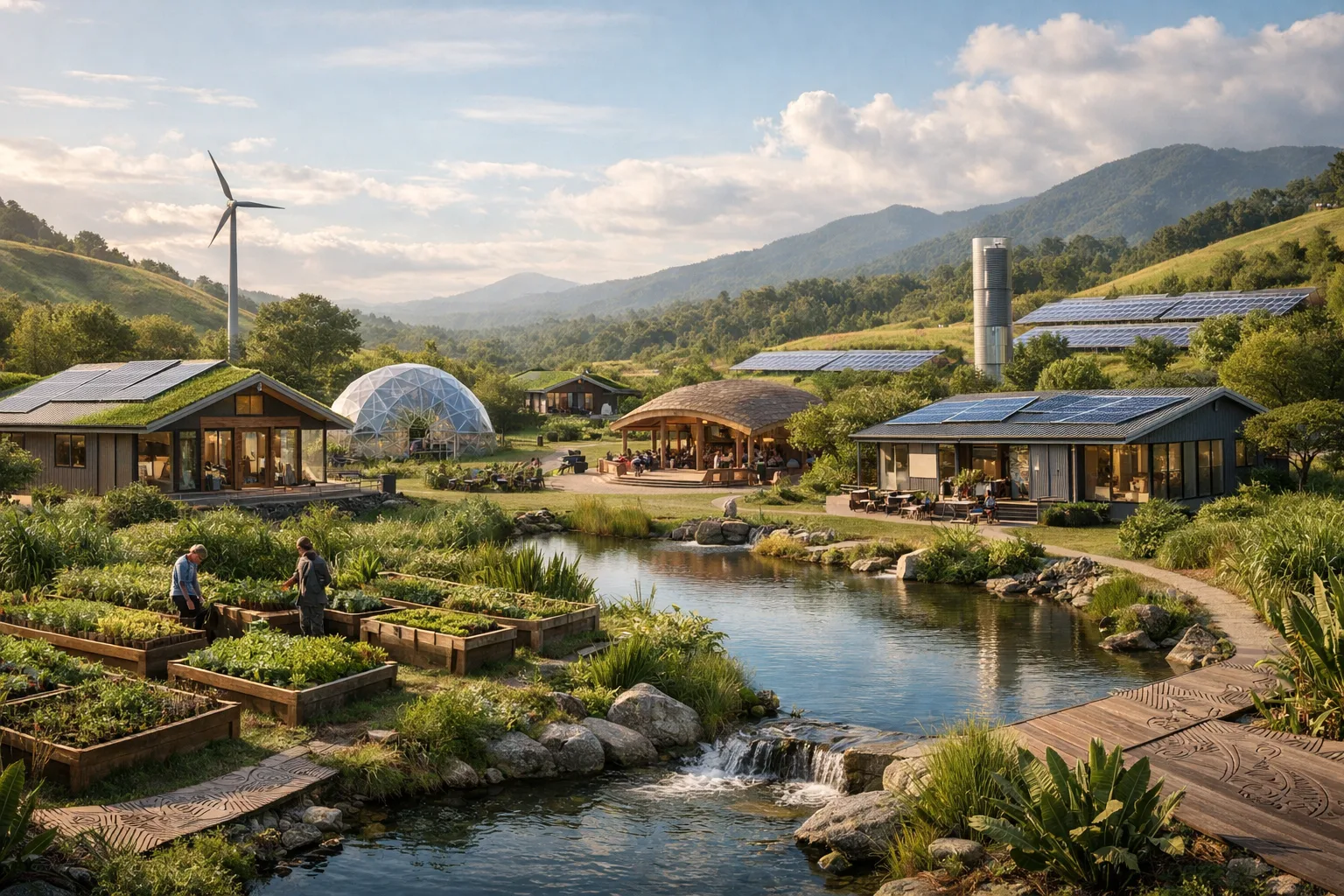
NeoBiome is a practice-based Masters research project at academyEX, asking whether emerging technology can make decentralised, self-sufficient eco-communities viable in Aotearoa New Zealand.
It set out to answer one question, through four smaller ones.
How might emerging disruptive technologies empower the development of decentralised, sustainable, self-sufficient and innovative eco-communities in Aotearoa New Zealand?
Is there real appetite, and what financial conditions make it feasible?
What is required, at what level, and where is the sensible balance?
Which technologies strengthen resilience and cohesion, not just capability?
What legal, planning and locational requirements must be met?
What was actually done
The question came from watching centralised systems fail: storms cutting regions off from power, roads and telecommunications for weeks, while the equipment to provide for yourself got cheap enough to buy in a shop. Over eighteen months the project interviewed eight people who have actually built these systems, surveyed twenty-two households on what they would want and pay for, and visited a cohousing neighbourhood that has run for fifteen years. Alongside that it built its own instruments: a knowledge system applying Andrej Karpathy's LLM-wiki pattern to hold every source as a checked document rather than a summary, and a tool that fuses national geospatial data so the self-sufficiency potential of any New Zealand site can be calculated rather than guessed.
- Institution
- academyEX, New Zealand
- Programme
- Master of Technological Futures
- Period
- February 2025 to September 2026
- Fieldwork
- April to June 2026
- Survey open
- 30 April to 31 May 2026
- Ethics approval
- MTF.8888.294
What this research produced
One artefact, and the four bodies of evidence and analysis behind it.
Neobiome Intelligence
Pick a place in New Zealand and it assesses how self-sufficient a community there could be, and roughly what it would cost.
The findings
AnalysisWhat the research concluded, and the report's own executive summary: four things that decide whether a community happens, the nine conditions behind the social one, and six rules that transfer where the numbers do not.
IIThe technology option space
AnalysisAll 161 options across ten domains, every one shown with the four filters it was judged against and the reasoning for adopting, watch-listing or ruling it out.
IIIThe interviews
EvidenceEight conversations with people who have actually built it: energy developers, a satellite data scientist, a biodynamic farmer, and the founder and a resident of New Zealand's most-studied cohousing neighbourhood.
IVThe survey
EvidenceTwenty-two households on what they would pay for, live in and share. Reported as counts, never percentages, because at this sample size a percentage implies precision the survey does not have.
Adam Wilder
A research master's student in the Master of Technological Futures programme at academyEX, New Zealand, investigating how community, regenerative systems and emerging technology converge toward more resilient ways of living.
Ethics approval MTF.8888.294
Participant information sheet available
Data collection closed June 2026